
LGBT Bucks
 Escape Website
Please be aware that the website will still be stored in you browser history. To avoid this, it is best to use Private/Incognito mode, if your browser supports it. For more information read our browsing safety advice.
Please see below information and advice regarding parenting, childcare, early education and legalities.
FosteringWith our newly revised allowance structure, bespoke training courses and committed approach to our carers – we have the power to make a huge difference with every new applicant to join our growing team of foster carers: now is the time to foster with Bucks.
To become a foster carer you need to have a spare room exclusively for the foster child; be over the age of 21; and passionately want to make a real difference in a vulnerable child’s life. We work with children from a variety o f backgrounds and of all ages. Right now, Buckinghamshire Council has over 500 looked-after children in its care, but is only able to place half of these children within the local area – whilst some of these cases are an intentional relocation, many come down to the availability of carers. we need more people to help us look after them and every new foster carer makes a huge difference.
If you want to find out more about what’s involved, sign up now to one of our Fostering Information Events.
Our informal and welcoming information sessions are a great way to find out more about fostering with Bucks. Any questions you have will be answered directly by our experienced team of recruitment officers. You will hear first-hand accounts from our long-term foster carers and the children they have cared for.
Take a look at our website where you can find details of other events taking place across the county throughout the year.
Single, married, disabled, from any ethnic or religious background or the LGBTQ+ community… Foster Carers come from all sorts of backgrounds. The one thing they all have in common is that they like children and are truly committed to helping them have the start in life they deserve.
If you think you’re up to the challenges associated with the rigours of parenting then please get in touch now to start your journey with us.
How to contact
If you are interested in fostering, please get in touch.
Online: fostering enquiry form
Email: fostering@buckinghamshire.gov.uk
Telephone: 01296 674973
Transgender Marriage & Civil PartnershipBuckinghamshire Registration Service is proud to serve the whole community with consideration and respect.
Civil Weddings

The Registration Service would be delighted to help you organise your wedding day and want to help make it special. You can get married in one of the ceremony rooms in Aylesbury, Beaconsfield, or High Wycombe or in one of the licensed venues of your choice. In Buckinghamshire, there are around 80 licensed venues to choose from, providing beautiful and stunning settings for your civil wedding – everything from historic buildings to comfortable modern hotels. The Registration Service will work with you to give you the ceremony you want.
Civil Partnerships
 Couples can also choose to form a civil partnership. You can choose to have a ceremony or just visit a register office and sign a schedule. If you decide to have a ceremony, the Registration Service will work with you to ensure this is personal and special to you both.
As with a civil wedding, you can form your partnership in one of the ceremony rooms in Aylesbury, Beaconsfield and High Wycombe, or in one of the licensed venues of your choice.
Converting a civil partnership into a marriage
Couples have the option of converting their existing civil partnership to a marriage, provided they registered the partnership in England or Wales. There is no obligation to convert your partnership to a marriage, this is purely a personal choice.
If you do decide to convert your civil partnership to a marriage, the Registration Service would be happy to help. You would need to attend a register office but it does not need to be the one where the partnership was registered. You don’t need to go through a marriage ceremony to complete the conversion. However, you may want to mark this as a special point in your relationship and you can opt for a celebratory ceremony at a venue of your choice. One of our experienced Registrars will listen to your wishes and tailor a ceremony to make it personal and meaningful to both of you.
Fees
Details of the fees for all the services can be found here.
How to contact us
Full information on the legal formalities and the options available for your ceremony can be found here.
The Registration Service is happy to answer your questions and accept bookings. Their offices are open Monday to Friday 9 – 4.30pm.
Adoption
Buckinghamshire Council’s Adoption Service
What the Adoption Service does:
- Recruit, assess, train and support prospective adopters.
- Assist in the planning and placement for adoption, of children who are not able to safely return to the care of their birth families.
- Provide assessments for adoption support as well as some direct services, including support groups for adopted adults, adoptive parents and adopted children.
- Work with adopted adults and their relatives who wish to trace or be reunited with birth relatives.
- Work with family and friend carers including foster carers and Special Guardians.
- Provide ongoing support for adoptive parents and their families including:
- Week day advice line
- Termly groups for primary and secondary aged children
- Regular training workshops for adoptive families
- Twice yearly social events for adoptive families and regular newsletters
What the Adoption Service needs:
- Adoptive parents for children aged 3-9 years
- Foster for early permanence carers for children aged 0-3 years
- Especially adoptive parents who will consider children:
- as part of sibling groups
- of black or dual heritage
- above the age of 3 years –
- to care for children with disabilities of all ages
Who can adopt?
The Adoption Service welcomes enquires from the LGBTQ+ community. If you are in a partnership, either through marriage, civil partnership or a stable living arrangement you can both legally adopt a child. You will need to demonstrate that your partnership is stable, permanent and will be able to withstand the challenges that adoption can bring. They would usually expect couples to have been together for at least 3 years.
Single people can also adopt. This arrangement can be seen as a positive choice for some children. As with people in partnerships, applicants will need to show that they have strong and supportive network of family and friends to call on when they need to. They will also need to consider arrangements in the event that single applicants become ill or unable to look after the child after adopting a child.
Support for Adoptive Parents
Provides support and advice to Adopters and Special Guardians who live in Buckinghamshire or where the adoption/special guardianship was arranged by Buckinghamshire Council.
Advice line is open
Mon, Thurs and Fri 9.30am-1pm Tues & Wed 1.30-5pm please phone 01494 586626.
All adopters and special guardians are entitled to an assessment of need on request until their children are aged 18. Buckinghamshire Council also offers a range of additional services over and above our statutory duty. Please call us to find out more.
If you are a birth parent or an adult adoptee and need some advice regarding adoption/special guardianship please contact Adoption Services.
Book onto an adoption information event | Buckinghamshire Council
Domestic Abuse
Domestic abuse occurs in same sex and transgender relationships too. Domestic abuse is experienced by anyone regardless of sexuality, age, gender origin, class, disability, race or religion. There is no excuse for domestic abuse towards any person and in any relationship at any time.
How do I know I am in an abusive relationship?
Abusive partners in LGBT relationships use the following types of abuse to gain power and control over their partners (the same as abusive partners exercise control in heterosexual abusive relationships):
- Psychological abuse
- Physical abuse
- Sexual abuse
- Financial abuse
- Emotional abuse
For further information, please see Domestic Violence and Abuse in LGBT+ Communities
Abusive partners in LGBT relationships use these tactics to maintain power and control alongside the complexities a survivor faces in leaving or getting safe in from an abusive LGBT relationship. The LGBT power and control wheel shows the different tactics and abuses used:
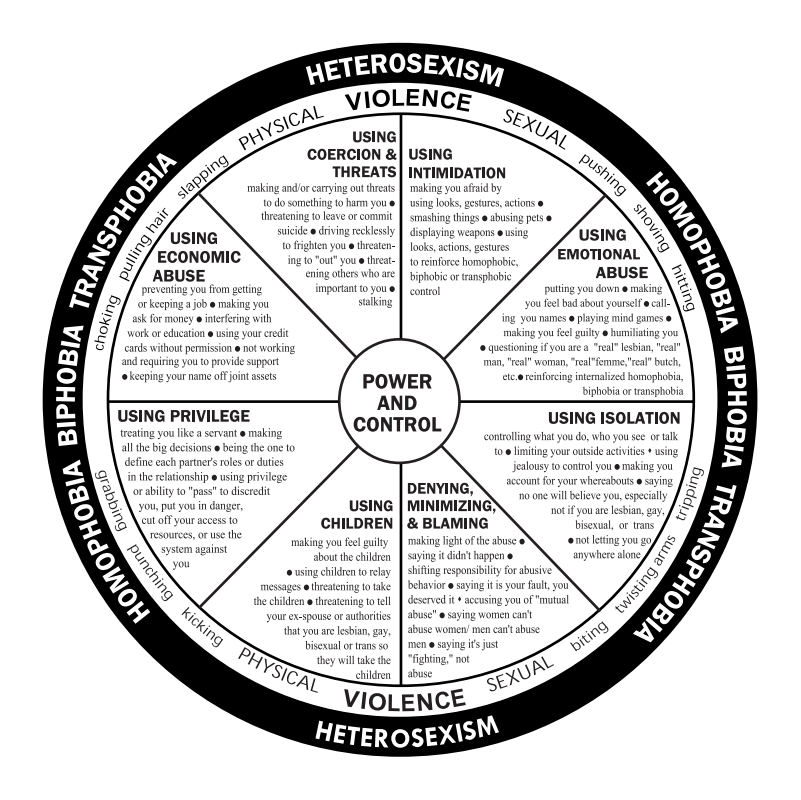
(Adapted from the 2011 Duluth Model Power and Control Wheels by Domestic Abuse Intervention Programs)
Myths associated with LGBT Domestic Violence & Abuse:
- An abuser will often manipulate their victim so that they feel they are to blame for the abuse. An abusive partner may say “this is how it is in a lesbian/gay/bisexual/trans* relationship”. There is nothing normal, appropriate or justifiable about LGBT domestic violence and abuse.
- An abuser may also play on myths about domestic violence and abuse to prevent his/her victim from seeking help by saying support services and reporting agencies are homophobic/ transphobic. In reality, the police have dedicated LAGLOs (Lesbian & Gay Liaison Officers) who are on hand to help.
- Abusers may attempt to convince their partner that no one will help them and that they are not entitled to legal protection from abuse from a same sex partner. This is not true.
- A common myth is that domestic violence and abuse does not happen in LGBT relationships. Actually the reality is 1 in 4 people are abused by a partner at some point in their lives. Abuse is never OK and nobody deserves to be abused.
For further information, please see Myths and Stereotypes
- Have a secret code to signal for help with a friend/neighbour so they are aware of when you need assistance
- Have a small bag ready with essentials (medication, civil partnership/marriage/birth certificates, bank information, passport, money etc) you may need should you have to flee the property in an emergency. Alternatively, leave this bag with a neighbour or friend
- Have some money stored should you need to use public transport to leave the property
- Keep with you any important and emergency telephone numbers
- If you are thinking of leaving the property make sure it is the safest time to do so, for example, whilst your partner is away from the property
- Take special care if you are considering leaving the home. Risk for a victim is highest when leaving their partner or shortly after, so make sure arrangements are in place or you know where to go should there be an emergency situation.
Domestic Abuse and Homelessness
There are options for people facing homelessness due to domestic abuse. You can contact your local domestic abuse services to see if they can find a refuge space for you. A refuge is somewhere safe to stay and can be anywhere in the UK.
There is a national organisation called Refuge who provide a 24 hour service for people needing assistance.
The National Centre for Domestic Violence can also help by applying for emergency injunctions and occupation orders which might enable you to remain in home and exclude the other person if it is felt safe to do so. You can also speak to a local solicitor who should be able to assist to. Please see contact numbers below for these services.
Am I Homeless?
Broadly speaking, somebody is statutorily homeless if they do not have accommodation that they have a legal right to occupy, which is accessible and physically available to them (and their household) and which it would be reasonable for them to continue to live in. It would not be reasonable for someone to continue to live in their home, for example, if that was likely to lead to violence against them (or a member of their family).
For further information, please see: The Homelessness Code of Guidance for Local Authorities
What can I do?
You can go to your local council and ask for assistance. Here is a Homelessness letter that you can fill out and take to them. It has been designed by the homeless charity Shelter to make sure that the local authority responds in an appropriate way to your request for assistance.
If you are homeless or threatened with homelessness, the council must decide if they also have reason to believe that you may be eligible for assistance and have a priority need for accommodation.
If there is reason to believe that you meet these criteria, the council have an immediate duty to ensure that suitable accommodation is available until they complete their inquiries and decide whether a substantive duty is owed under Part 7. This is an important part of the safety net for people who have a priority need for accommodation and are unintentionally homeless.
Do I have a priority need?
The Housing Act ( Part 7 of the Housing Act 1996.) defines ‘priority need’ in England (and Wales) to include:
- a pregnant woman
- dependent children
- someone vulnerable as a result of old age, mental illness or handicap or physical disability or other special reason
- someone homeless or threatened with homelessness as a result of an emergency such as flood, fire or other disaster
This was expanded further still in England by the 2002 Homelessness (Priority Need for Accommodation) (England) Order to include those:
- aged 16 and 17 years old
- aged under 21 years old who were in local authority care between the ages of 16 and 18
- aged 21 and over who are vulnerable as a result of leaving local authority care
- vulnerable as a result of leaving the armed forces
- vulnerable as a result of leaving prison
- vulnerable as a result of fleeing domestic violence or the threat of domestic violence
Housing authorities must ensure that suitable accommodation is available for people who have priority need, if they are eligible for assistance and unintentionally homeless (certain categories of persons from abroad are ineligible.) This is known as the main homelessness duty. The housing authority can provide accommodation in their own stock or arrange for it to be provided by another landlord, for example, a housing association or a landlord in the private rented sector.
If settled accommodation is not immediately available, accommodation must be made available in the short term until the applicant can find a settled home.
For more information on LGBT domestic abuse advice visit www.reducingtherisk.org.uk
Safety & CrimeStaying safe when you’re out and about
 If you often walk home in the dark, get a personal attack alarm from a DIY store. Carry it in your hand so you can use it immediately to scare off an attacker. Make sure it is designed to continue sounding if it’s dropped or falls to the ground.
- Carry your bag close to you with the clasp facing inwards.
- Carry your house keys in your pocket.
- If someone grabs your bag, let it go. If you hang on, you could get hurt. Remember your safety is more important than your property.
- If you think someone is following you, check by crossing the street – more than once if necessary – to see if they follow. If you are still worried, get to the nearest place where there are other people – a pub or anywhere with a lot of lights on – and call the police.
- If you regularly go jogging or cycling, try to vary your route and time. Stick to well-lit roads with pavements. On commons and parklands, keep to main paths and open spaces where you can see and be seen by other people – avoid wooded areas. If you wear a personal stereo, remember you can’t hear traffic, or somebody approaching behind you.
- Avoid taking late night short-cuts through dark alleys or parks. Walk facing the traffic so a car cannot pull up behind you unnoticed.
- If a car stops and you are threatened, shout and set off your personal attack alarm if you have one. Get away as quickly as you can. This will gain you vital seconds and make it more difficult for the car driver to follow.
- If you can, make a mental note of the number and description of the car. Write down details as soon as possible afterwards.
- Don’t hitch-hike or take lifts from strangers.
- Only use licensed taxis. Ensure the driver is wearing their driver’s badge and make sure that the vehicle displays a white plate at the rear of the vehicle.
- When booking a private hire vehicle pre book and agree the fare when booking. Make sure you’re entering the correct vehicle and confirm the booking with the driver who should be wearing a badge. If you have any doubt that the taxi is legitimate don’t get into the vehicle.
- Join Thames Valley Alert
For more advice on personal safety see the Suzy Lamplugh Trust website.
Reporting Crimes and Incidents
You should call 999 in an emergency where;
- There is a risk of serious injury
- There is a risk of serious damage to property
- You suspect a crime is in progress
- It is a serious incident which needs immediate police attention
Non-emergency
If it is a non-emergency
- call the police on 101
- call into any police station
Sexual Violence

It is important to remind yourself that you are not to blame. Nothing that you have done can make a person rape or sexually assault you. You are not responsible for someone else’s actions. There is help and support locally which is listed below.
Hate Crime
The Gov.uk definition is “Crimes committed against someone because of their disability, gender-identity, race, religion or belief, or sexual orientation are hate crimes and should be reported to the police”. A hate crime or incident is any act that is motivated by a hostility or prejudice towards a specific part of someone’s identity. In the case of the LGBT community, this means any act of hostility towards a person’s sexuality or gender identity. It does not matter whether the individual in fact identifies themselves as within any of these groups – it can simply become hate-related if it is based upon a person’s perceived sexuality or gender identity.
Hate crimes can include:
- threatening behaviour
- assault
- robbery
- damage to property
- inciting others to commit hate crimes
- harassment
Types of incidents:
Verbal abuse – any kind of offensive or derogatory language; e.g. name calling in the street because you are holding hands with your same sex partner, or coming out of a LGBT venue
Harassment – abusive phone calls, hate mail, online bullying
Physical abuse – any act of violence or threat of violence can constitute a hate-motivated assault (i.e. kicking, spitting, punching, slapping)
Criminal damage – this could include vandalism or graffiti to your home or vehicle
If the incident constitutes a criminal offence it becomes a ‘hate crime’. Hate crimes can carry tougher sentences at court.
The police take these kinds of reports very seriously, however they are still massively under-reported. Even if the incident doesn’t constitute a crime, there are still things the police or local agencies can do to help, whether it be to support you or safeguard others from similar incidents. The police are keen to understand hate crime in the local area in order to better deal with it.
 How to report:
If you think you have been a victim or you have any information about a hate crime or incident, make sure you report it. You can do so in a number of ways:
Via the police:
Online – via the Thames Valley Police website
Phone – always call 999 in an emergency if there is a crime in progress or there is serious risk of immediate harm to life or property.
Alternatively, call 101 to speak with Thames Valley Police.
If you wish, you can request to speak with a LAGLO (Lesbian and Gay Liaison Officer). A LAGLO is a police officer or member of police staff who has specialist training in, and a specific understanding of, lesbian, gay, bisexual and transgender issues. This expert knowledge and understanding offers a critical additional resource not only to Thames Valley Police but also lesbian, gay, bisexual and transgender (LGB&T) communities and individuals.
Embracing and considering all aspects of policing, the role is designed to assist the maximization of service delivery opportunities to improve confidence, trust and communication between Thames Valley Police and LGB&T communities and individuals.
There is already a demand for LAGLO assistance across the Thames Valley Police area. So, if you would like to get in contact with your local LAGLO, please call Thames Valley Police on 101 and ask to be connected.
Third-party reporting options:
If you don’t want to report it directly to the police, there are options to report it via third-parties such as :
Coming OutMany people think about “coming out” as one big event that happens and then the person is established as LGB or T. In reality, coming out is a process that continues all through life.
 The initial disclosure to friends, parents, or family members may be the most difficult, particularly for people whose friends and family are not supportive and accepting of the LGBT person. Even people who are generally supportive of LGBT rights may have difficulty accepting their own son, daughter, brother, or sister as gay. If you are a young person still dependent on your parents, this can be particularly risky. LGBT young people are more likely to find themselves homeless than their non LGBT peers comprising up to 24% of the youth homeless population (AKT 2015, Cull et al 2006). If you are living independently, you may still fear rejection or just a change in your relationships with family members. Even your closest friends and family members may look at you differently and it can take time for everyone to adjust.
People who love you will often come around given time, regardless of their own views on homosexuality. It can help if you are prepared to answer their questions, or refer them to guides like the ones listed below. You may be able to give reassurance that being gay doesn’t prevent you from getting married, having kids, and doing all the things heterosexual people do. It is important however to remember that regardless of your sexual orientation, everyone has the right to privacy. If you are being asked intimate or personal questions, point out that the person asking wouldn’t be comfortable with you asking the same questions of them. Sexuality and relationships are intimate and private between the people involved, and you shouldn’t be pressured to discuss these details.
 With time and tolerance, most gay people have close and productive relationships with friends and family. This is reliant on the LGBT person being comfortable with themselves. There are many sources of support available, but if you can’t find any you can check out the Stonewall website for advice and information. Remember that mainstream health providers no longer consider being gay or transgender a ‘phase’ or a problem that can be fixed. NHS services for transitioning and IVF are now provided. Most religions also now recognise same sex relationships, and if you belong to a church or congregation that doesn’t support you, it is worth looking for one which does.
Once the first ‘coming out’ has occurred, there is still the question every time you meet a new person about if or when to tell them. This includes professionals such as your doctor, acquaintances such as neighbours or colleagues, people who come to your house such as tradesmen or delivery people and those who interact with your children such as teachers. Fortunately recent years have seen great progress in LGBT rights. Media portrayal of LGBT people has helped to normalise this minority and social tolerance has increased. The documentary television series ‘TransParent’ highlights the invisibility of transgender parenting in society, while the comedy series ‘Modern Family’ shows how a gay couple and their daughter have the same issues as any other parents.
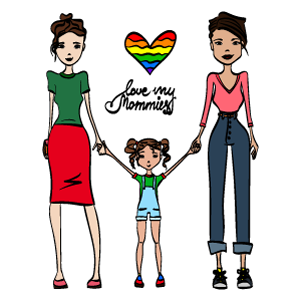
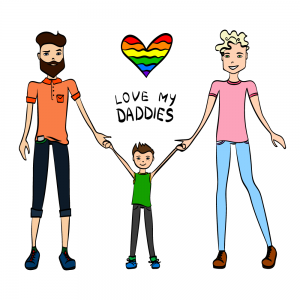
Despite progress in this area, most people still assume that others, especially parents, are heterosexual. ‘Coming out’ or being ‘outed’ by your children should result in an apology from the person making the heterosexual assumption. It can be useful to use the generic word ‘partner’ when you aren’t comfortable coming out to a passing acquaintance, however gendered pronouns can still inadvertently ‘out’ gay people. Many LGBT people become adept at censoring their language so as not to be outed accidentally.
‘We saw the new Star Wars film this weekend but I was the only one who enjoyed it.’ is better than, ‘My other half and I saw the new Star Wars film this weekend. I liked it, but my partner (or he, or she) did not.’
Regardless of the circumstances, any time a person decides to trust someone else enough to ‘come out’ to them, emotions and expectations can run high. It is important that those on either side of the conversation remember that they are each still the same people they were before, they just have an opportunity to know and understand each other a bit better.
Stonewall’s Support And Advice For Parents Of LGBT Young People
Stonewall’s Support And Advice Coming Out As A Young Person
Sexual HealthWhen it comes to safer sex and avoiding sexually transmitted infections, it is important that you know how to protect yourself and the person you are having sex with, regardless of who you are attracted to.
For everything sexual health related in Bucks, visit www.sexualhealthbucks.nhs.uk.
Use the service finder to locate your nearest bSHaW Sexual Health clinic in Buckinghamshire, including Walk-in Clinics, or call 0300 303 2880 to book an appointment. You can also order a free confidential postal chlamydia kit online.
Men who have sex with men
Data is telling us that men who have sex with men are disproportionately affected by some sexual infections.
For MSM service users we offer:
- Full sexual health screening and treatment for all infections • Screening for Hepatitis C • Hepatitis B vaccination • Option for self-taken swabs • HIV Point of Care Testing (find out your results instantly) • PEP (Post Exposure Prophylaxis) and when you need to take it • Information and advice on condoms, chemsex, alcohol and safer sex
- It is recommended that MSM have annual checks; or every three months if you have multiple partners.
Read more here.
Women who have sex with women
The risks are lower, but women who have sex with women can still pass on sexually transmitted infections. Know how to protect yourself.


Social Care & Wellbeing
Emotional health is an important part of everyone’s life, but it can be especially important for LGBT people when: dealing with gender identity issues, coming out, meeting other LGBT people, starting a family or starting new relationships. LGBT people can often find it difficult to seek support, but it’s important that you feel able to ask for the support that you need.